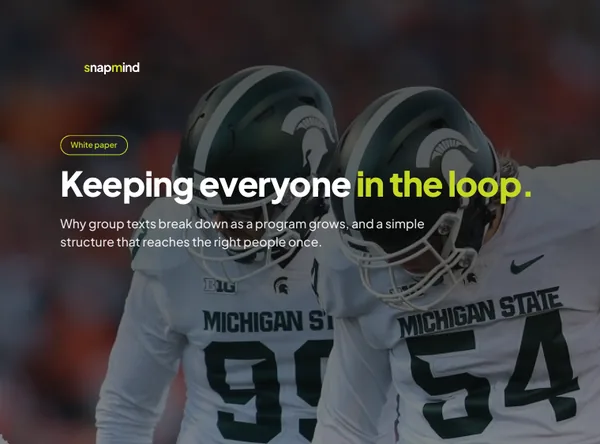

White paper. For parents and guardians
A parent's guide to the season
How to keep up with schedules, forms, fees and rides, and how to support your athlete as they work toward the next level.

The short answer
A sports parent stays ahead of the season by finishing forms and fees before the first practice and keeping a simple weekly routine for the schedule and rides. Check the calendar and announcements before contacting a coach, and keep questions short and specific. An athlete who wants to play in college needs a parent who quietly keeps records and film links organized.
On this page
Being a sports parent is a part-time job nobody trained you for. Forms and fees both come with deadlines, the schedule moves, rides need arranging and there is a coach you want to respect. This guide is a short, practical way to stay ahead of all of it.
Before the first practice.
| Task | Why it matters |
|---|---|
| Sign the consent and waiver forms | An athlete usually cannot practice until these are on file. |
| Turn in the physical and any required certifications | Programs need them on file, and they expire. Note the date. |
| Confirm emergency contacts and medical notes | If something happens, the coach needs the right number in seconds. |
| Check the fees and the deadline | Ask early if the amount is a problem. Programs can often help, and an early conversation is easier for everyone. |
| Join the program's app and turn on notifications | Changes to practice or game times go out once, and notifications are how you see them. |
During the season: a simple weekly rhythm.
- Sunday. Open the calendar and look at the week. Write down arrival times as well as start times.
- Midweek. Check for forms or fees that need you, and answer RSVPs when they are asked.
- Game day. Confirm uniform, arrival and ride the night before, and have your athlete pack their own bag.
- After the game. Say less than you think you should. Ask what they enjoyed and let the coach handle the rest.
Communicating with coaches.
Coaches are overloaded in the evenings, and most of the questions they get are already answered somewhere, so check the calendar and the announcements first. When you do reach out, keep it short and specific and use the channel the program has set up. Questions about playing time and strategy are best raised through your athlete first, and then with the coach at a calm moment well after the game.
Travel and rides.
For away games and tournaments, programs often share a hotel block with a booking link and a cutoff date. Book inside the block and use the confirmation in the app so the coach knows who is covered. Rides work best when a family offers seats early and the others claim them with a name and a phone number.
Supporting the path to the next level.
If your athlete wants to play in college, your most useful job is to be a quiet organizer. Keep a folder of academic records and film links, and help them keep a recruiting page current, approving it once it is accurate. Let them write the emails to coaches and make the calls, because staffs are looking at the athlete and they notice who is doing the work.
Your child's information.
- Athletes under 13 are held on a parent's account and never receive credentials of their own.
- Athletes aged 13 to 17 can see the schedule and announcements, and messages, a profile photo and recruiting open once you approve.
- A recruiting page stays private until both the coach and a parent approve it.
- You can ask to see, export or delete your child's data through the program's privacy portal.
About the author
Michael Donovan is the founder and CEO of SnapMind. He was a long snapper at Michigan State and the University of Miami.
Parents can find the schedule, forms, fees and rides for each child in one app. You can read about what parents see in SnapMind Teams or browse the rest of the SnapMind Library.
Download the PDFAnswer three short questions and the PDF downloads.